
Image credit: Tidewater EMS Council
EMS Week is an ideal time to hold a blood drive, but the truth is that blood donors are needed every day of the year. What follows here is advice from agencies around the country with experience organizing, promoting and running blood drives with a blood center. Each of these EMS organizations has a prehospital blood transfusion program, but you don’t need to have a program to hold a drive; donations are always welcome.
- Find your partner. As an EMS agency, you don’t need to be an expert in blood donation. The blood center you work with to co-host a drive will provide the equipment and trained technicians to handle the actual donations; most will support you in other ways as well, including helping you to promote the event (more on that below). You can find potential blood centers to work with through the American Red Cross, America’s Blood Centers, Blood Centers of America, Inc., Vitalant, or by searching on the website for the Association for the Advancement of Blood & Biotherapies (AABB). There are also regional organizations, including Carter BloodCare, OneBlood and ImpactLife, you can choose to work with.
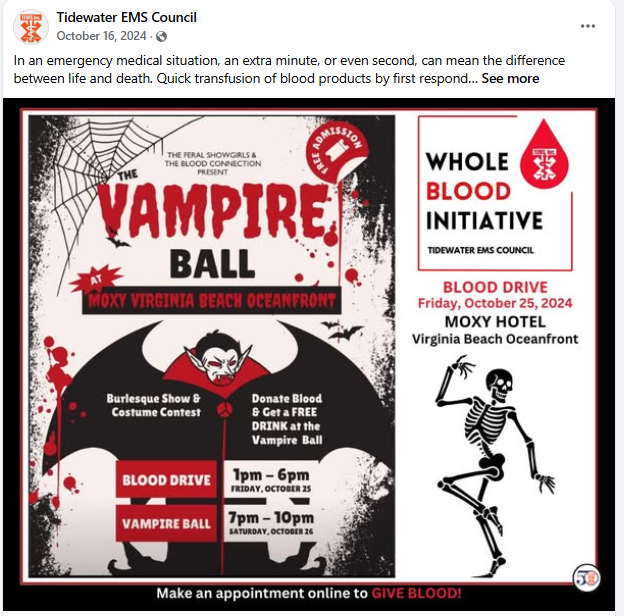
- Choose a date and location. If you want to hold a drive as part of your EMS Week activities, consider scheduling it for “Save-A-Life Day” on Thursday, May 21, 2026. Many agencies use this day to promote their Stop the Bleed, CPR training or other public programs. Consider also hosting blood drives on a weekend or evening to make it easier for donors to attend. In 2024, Tidewater EMS Council in Virginia held a blood drive in tandem with a “Vampire Ball” around Halloween, creating social media posts playing on the theme to attract donors.
- Promote from within. When Howard County Department of Fire and Rescue Services in Maryland launched its prehospital blood transfusion program in 2023, leaders anticipated that their blood supply partner, Inova Blood Services, would expect the agency to help replenish the supply. They turned to their own personnel first. Today, the department hosts two large blood drives each year, drawing 30 to 50 participants per event and generating roughly 70 units of blood annually, more than covering the approximately 25 units used for EMS patients last year.
Tidewater EMS Council, which represents nearly 60 EMS agencies and more than 10 hospitals, has similarly relied on participation from the public safety community, while also exploring ways to expand engagement and encourage more community members to become regular donors. - Promote to everyone else. The most important role for EMS in holding a blood drive is getting the word out to potential donors and doing what you can to ensure they show up. For starters, stresses Dr. Levy, “work with your public information and media people on the messaging to the community, so the community knows you’re doing this and can help with blood drives.” If your agency does have a prehospital transfusion program that has resulted in lives saved, these stories can be very effective in grabbing the public’s attention, notes Long. “If you had a case like this and the local news media did a really good job of explaining that this person is alive today because they received a blood transfusion by EMS, that compels people to come out and donate blood.”
Tidewater EMS Council also uses social media to push news about their program (including upcoming drives) and also engages with local media and distributes flyers throughout the community. “Over the course of the past three years we’ve been developing our donor pool, meaning people who have donated previously in our drives,” says Long. “They automatically get an email notification that we’re conducting another blood drive and that we’d love to see them come back.” Tidewater offers incentives and organizes friendly competitions between jurisdictions to see who can tally the most donated units.
“My contractual obligation is to do four drives per year, but I’m trying to get to where we do a blood drive monthly,” Long explains. “I’m reaching out to other businesses…to reduce the public safety burden to give blood.”
Since launching their prehospital blood transfusion program in 2024, Crawfordsville Fire Department in Indiana has held three drives (the contract with their blood supplier, Versiti, stipulates a minimum of three drives per year). Each one has been a learning experience, says Captain Bryan Shaw, from scheduling drives so they don’t overlap with other blood drives in the city to understanding exactly how blood donation works. “For our second drive, we promoted it as ‘come donate with the fire chief,’ and we fell one day short of his being able to donate again,” explains Captain Shaw, adding that Crawfordsville has had great success offering incentives to donors. “The third one, held on a Saturday, seemed to work out much better. We had 34, 35 units of blood or blood products,” he continues. “The one thing that people seemed to really want were the challenge coins we gave out at that one. We gave those to anybody that donated and people said that that was the reason they were there, was for the challenge coins.”
Colorado Springs Fire Department also leverages the unique role of EMS and fire in the community when promoting blood drives. The department incorporates firefighters in boots and bunker gear alongside fire engines to draw attention and encourage participation, using their visibility and trusted status to motivate donors. In partnership with its blood-supply partner, Vitalant, these efforts have resulted in some of the most successful drives in the region. The department also views this work as part of its responsibility, recognizing that if it is using blood products, it should play an active role in helping collect and replenish them.
To learn more about how to hold a blood drive, use the newly updated EMS Blood Drive Toolkit as a guide in planning, promoting and hosting your drive, and visit emsweek.org for more ideas for celebrating EMS Week 2026.